
Porter County Court Records After Arrest
The court-record path starts after booking at the Porter County Jail. The jail profile may show arrest charges, a booking date, the arresting agency, statute codes, and bond fields entered during intake. Those entries are not the final court record. After a Porter County arrest, the prosecuting attorney reviews the police report and decides what charges to file in court. Once that filing is docketed, the public case record can appear in Indiana MyCase when the case is not confidential, sealed, expunged, or otherwise restricted.
That split matters. Jail booking data explains custody and intake. Court records explain the filed case. For custody status, booking fields, and the current roster, use Porter County jail inmate records. For booking photos and recent booking cards, use Porter County jail mugshots. For the filed charge, hearing dates, case events, bond orders, and final disposition, use MyCase or the Porter County Clerk. PCSO's arrest-record-check page warns that arrest and booking information does not determine a person's actual criminal record and does not reflect court charging decisions or trial outcomes.
The local offices are split by function. The Porter County Sheriff's Office and Porter County Jail are at 2755 State Road 49 in Valparaiso. The Clerk's Valparaiso court office is downtown at 16 Lincolnway, Suite 211. The Porter County Prosecutor is also downtown at 157 S. Franklin Street, 3rd Floor. A person can be held at the jail while the court case is handled through these separate court and prosecutor channels.
Find Porter County Court Records
Porter County directs adult case searches to its Free Access to Adult Court Case Records page and to Indiana MyCase. The county says adult Porter County cases can be searched by name, case number, traffic citation number, or attorney. Indiana's MyCase help page explains that public non-confidential cases from courts using Odyssey can be searched online, but electronic access is not the official court record. If a needed public document is not linked online, the county clerk is the fallback.
The county gives a specific case-number rule. Do not enter spaces or dashes. The last set of numbers must have six digits, and every court case number has 17 digits. Porter County gives an example where a cause number written as 64D05-1608-CB-8135 or 65D05-1608-CB-008135 is entered as 64D051608CB008135. Name searches are useful after a new arrest when the cause number is not yet known.
| MyCase Search Field | Type | Required | Porter County Use |
|---|---|---|---|
| Name | Text | Optional by mode | Search by defendant or party name. Try spelling variations if the arrest was recent. |
| Case Number | Text | Optional by mode | Enter the 17-digit number with no spaces or dashes and a six-digit final set. |
| Traffic Citation Number | Text | Optional by mode | Use for citation-based traffic cases that may follow an arrest or summons. |
| Attorney | Text | Optional by mode | Search by attorney when party information is uncertain. |
| County or Court Filters | Dropdown or filter | No | Narrow results to Porter County or the relevant court when the portal offers filters. |
The official Porter County court-records page shows the local MyCase guidance used for adult case lookup. The screenshot is from Porter County's adult court case records page.
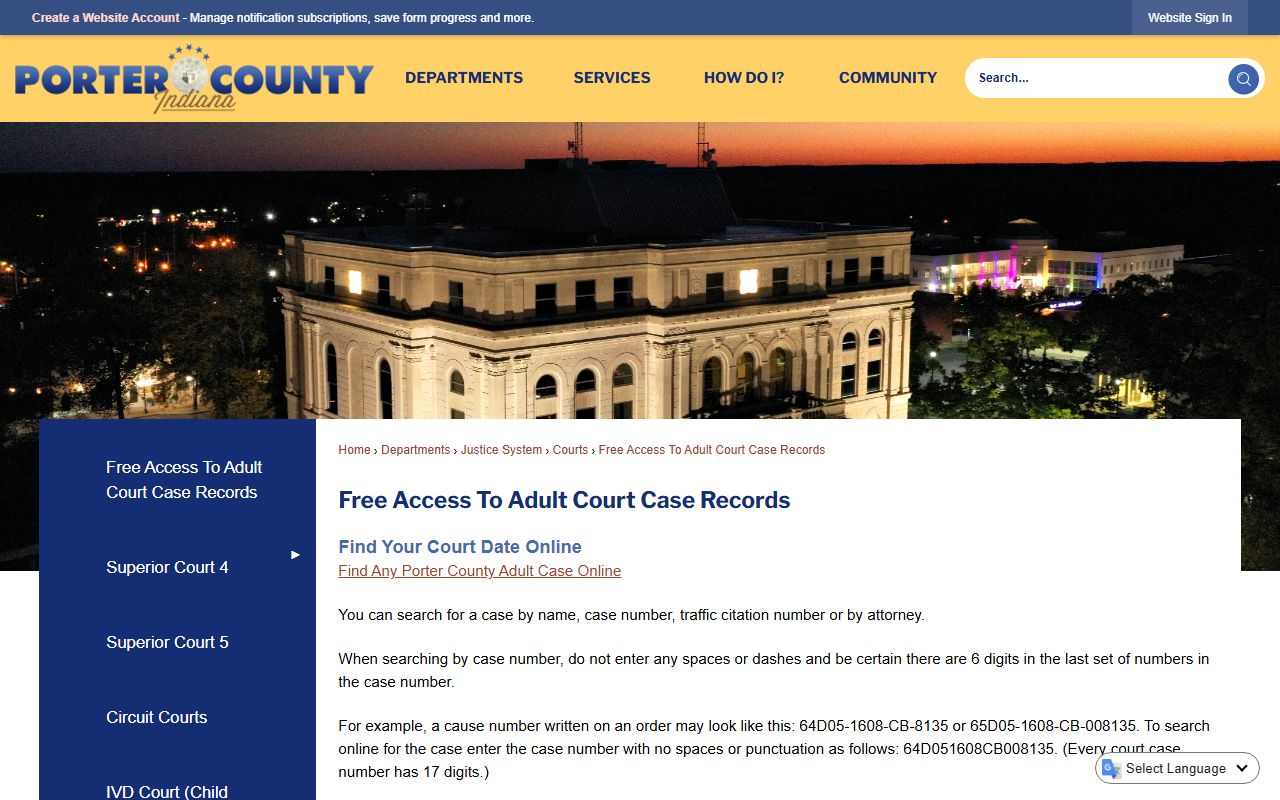
This source is useful because it gives the Porter County case-number format rule, which is easy to miss when a cause number is copied from a bond sheet or court notice.
Porter County Arrest to Court Path
A Porter County arrest does not always become the same charge list in court. Police or jail staff may enter booking charges during intake. The prosecutor then reviews reports, evidence, probable cause, prior case history, witness information, and any legal limits before filing charges. Indiana uses county prosecuting attorneys rather than district attorneys. In Porter County, Prosecuting Attorney Gary S. Germann's office handles criminal prosecution for the county.
- A law enforcement agency arrests or delivers the person to jail custody.
- Porter County Jail creates the booking record, including booking charge data and bond fields where available.
- The prosecutor decides whether to file a criminal case and which counts to file.
- The court opens a public case record if the filing is docketed and not confidential.
- The initial hearing addresses rights, filed charges, bond, release conditions, and future court dates.
- The case record then tracks amended charges, hearings, warrants, pleas, dismissals, trial events, and disposition.
Search timing can be uneven. A new booking may show on the PCSO roster before a criminal case appears in MyCase. The reverse can also happen for warrants, summons cases, probation violations, or older matters where the court case exists but the person is not in current custody. If the arrest is very recent, re-check MyCase and call the Clerk's Office rather than assuming no case was filed.
Local distinction: The Porter County Jail record is a custody record. MyCase and the Clerk's Office are the court-record channels for filed charges and final disposition.
Porter County Charging Documents
The charging document is the court filing that turns an arrest event into a formal criminal case. The exact document depends on the case type and procedure. Readers often see the words complaint, information, or indictment and treat them as the same thing. They all can start or support a case, but they do not carry the same role.
| Document | Who Uses It | What It Does | Why It Matters |
|---|---|---|---|
| Complaint | Law enforcement or prosecutor | States facts or allegations supporting a criminal charge. | May be the first document tied to probable cause after arrest. |
| Information | Prosecutor | Lists the formal criminal counts the prosecutor files with the court. | Often shows the filed charges that should be compared with jail booking charges. |
| Indictment | Grand jury process | Charges an offense after grand jury action. | Less common for routine local cases, but it is still a formal charging route. |
In practical terms, a Porter County search should focus on the filed count list and the chronological case summary. The count list shows each charge in court. The chronological case summary, often called the CCS, shows docket events such as initial hearings, warrant entries, bond orders, continuances, plea hearings, trial settings, dismissal entries, and sentencing entries when those events are public.
Porter County Charge Status
Charges can change after the first filing. A count can be amended, reduced, added, dismissed, or resolved by plea or trial. That is why a jail profile and a court case can seem inconsistent. The jail profile reflects booking information and bond data known at intake or updated in custody systems. The court record reflects what the prosecutor filed and what the judge entered in the case.
| Status | Plain Meaning | Search Tip |
|---|---|---|
| Pending | The charge is open and not yet resolved. | Check future hearing dates and bond orders in MyCase. |
| Amended | The filed charge was changed by later filing or court action. | Compare the original count with the newest count text. |
| Reduced | The charge level or offense was lowered. | Look for plea entries or amended information filings. |
| Dismissed | The charge ended without a conviction on that count. | Review whether other counts in the same case remain open. |
| Convicted | The person was found guilty or entered a guilty plea. | Use the disposition entry, not the booking charge, as the court outcome. |
| Acquitted | The person was found not guilty after trial. | The arrest may still have occurred, but the charge did not result in conviction. |
PCSO's arrest-record-check warning fits this point exactly. It says arrest checks include verified arrest and booking information in Porter County, but they should not be used to determine actual criminal record. Final disposition must come from the court or clerk. For older, offline, sealed, or unclear results, contact Clerk Jessica A. Bailey's office at the Valparaiso courthouse.
Bond After Porter County Arrest
Indiana bail and bail bonds are governed by Indiana Code 35-33-8. In Porter County records, bond can appear in more than one place. A jail profile may show bond fields by charge. A court order may set, change, or remove release conditions. MyCase may show case financial information, but the Judicial Branch warns that electronic information can have errors or omissions and is not the official court record.
| Bond Type | How It Works | Porter County Caution |
|---|---|---|
| Cash | Money is paid as required by the release order. | The sample PCSO profile showed cash bond data repeated per charge. |
| Surety | A licensed bail agent posts bond under Indiana rules. | Confirm the court will accept surety for the case before paying a fee. |
| Personal recognizance | Release is based on a promise to appear, often with conditions. | MyCase may show conditions or hearing entries when public. |
| No-bond hold | Posting money will not cause release until the hold is resolved. | Other warrants, probation matters, USMS, ICE, or another county can block release. |
Before paying or traveling, call the Jail Division at 219-477-3050 or check with the clerk or court. Bond can change after first appearance. A person may also remain in custody on another agency hold even when one Porter County charge has a listed cash amount.
Porter County Warrant Records
PCSO has an official Warrant Search page, but the page displayed "Check back later for updates" when inspected. Treat it as an official page without an active public warrant database at that time. If a warrant has already led to a booking, the person may appear on the Who's In Jail or Recent Bookings pages. If the warrant is tied to a court case, MyCase is the better source for bench warrants, failure-to-appear entries, and related docket events.
A warrant can also explain why a person remains in custody after bond seems available. A bench warrant is issued by a judge, often after failure to appear. An arrest warrant directs law enforcement to take a person into custody. A fugitive hold or out-of-county warrant can keep a person jailed until another agency acts. For legal advice or warrant clearance, contact the court, clerk, sheriff, or an attorney. A public web search is not enough to resolve a warrant.
Porter County Charges and Convictions
A charge is an accusation filed in court. A conviction is a court outcome. The difference is central to Porter County court records after a jail arrest because the booking photo, roster entry, or filed count does not prove guilt. A case may end in dismissal, acquittal, diversion, plea, conviction, or another court outcome.
| Point | Charge | Conviction |
|---|---|---|
| Stage | Filed accusation after arrest or summons. | Final or count-level finding after plea, trial, or judgment. |
| Proof level | Based on probable cause and prosecutor filing rules. | Requires guilty plea, guilty finding, or judgment of conviction. |
| Record meaning | Shows what the state alleged. | Shows what the court resolved as guilt on that count. |
| Where to confirm | MyCase count list and filings. | Disposition and sentencing entries from the court or clerk. |
For employment, housing, credit, insurance, or tenant screening, casual web searches are the wrong tool. Those uses can trigger Fair Credit Reporting Act duties and should rely on lawful, compliant background-check processes.
Porter County Sealed Records
Indiana public access is broad, but it has limits. The Indiana Access to Public Records Act makes public records available unless a statute or rule blocks access. Indiana Code 5-14-3-4 covers confidential and discretionary withholding categories, including investigatory records. Indiana Code 35-38-9 governs expungement for eligible arrests and convictions.
| Point | Sealed | Expunged |
|---|---|---|
| Public view | Public access is restricted by order, rule, or case status. | Access is limited under Indiana's expungement process for eligible records. |
| Where it may still exist | The court or agency may retain restricted internal access. | Law enforcement or court access may remain in limited settings under law. |
| How to verify | Contact the clerk for the court maintaining the record. | Review the expungement order and ask the clerk or attorney about scope. |
| Online result | May not appear in MyCase public access. | May not appear publicly after proper court action. |
Juvenile matters, confidential cases, sealed cases, expunged cases, and some protected identifying information may be withheld from public online access. If a record cannot be found, that can mean no case exists, the case is too new to appear, the search fields are wrong, or access is restricted.
Porter County Court Contacts
The Clerk's Office is the official court-record fallback when MyCase does not provide enough information. The Prosecutor's Office is not a records desk for private background checks, but it is the office that decides what criminal charges to file after a Porter County arrest. PCSO Records handles arrest-record checks and case or crime report requests, which are separate from final court dispositions.
Porter County Clerk's Office
Jessica A. Bailey, Clerk of the Courts
16 Lincolnway, Suite 211
Valparaiso, IN 46383
219-465-3450
Monday-Friday, 8:30 a.m.-4:30 p.m.
Porter County Prosecutor
Gary S. Germann, Prosecuting Attorney
157 S. Franklin Street, 3rd Floor
Valparaiso, IN 46383
219-465-3415
Indiana SAVIN and VINELink are useful when the main question is custody status or release notification rather than a court filing. Search Indiana SAVIN by last name, offender identification number, or case number when notification is the goal.